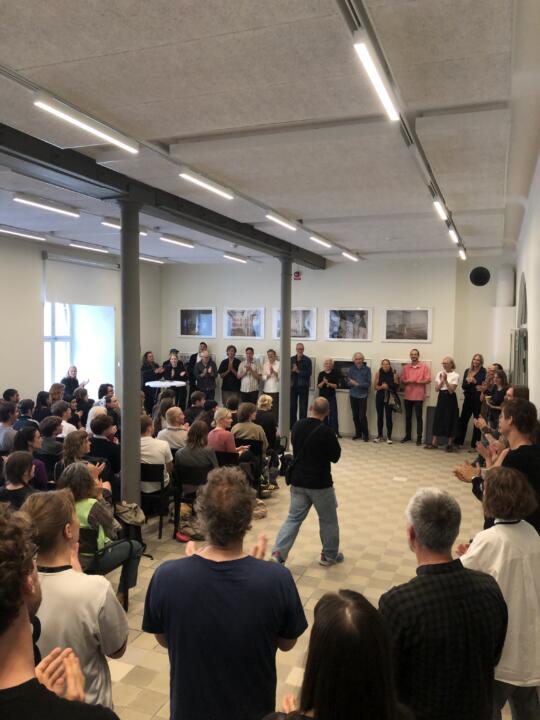
The following is a text version of the speech given by Sanne Kofod Olsen, Vice-Chancellor at the Royal Institute of Art, on 2 September 2026, welcoming students to the Fine Art programme. The speech was given in English.
It is a great pleasure to welcome you to Mejan!
There is something special about the beginning of an academic year. We welcome new students and new possibilities, while saying goodbye to those who have just completed their studies. Only last Friday, some of our recent graduates, who attended the summer course, packed up their studios and moved out. It is always a bit sad to see them leave. Over the years, they become part of the life of this place. And then, almost immediately, our attention turns towards those who are arriving.
Endings and beginnings. One group leaves, another arrives, and the school changes again. Organizations, such as art schools, are not static structures, but rather continuous processes of ‘sensemaking’ (a term defined by organizational sociologist Karl Weick) – creative spaces where people constantly try to construct meaning out of shared, ambiguous experiences. As one generation of students hands over the keys to the next, you are not just entering a fixed institution. You are actively stepping into a community and into a place that is itself always in the making.
Kungl. Konsthögskolan – the Royal Institute of Art, or simply Mejan – has roots going back to 1735. That means 291 years of educating artists. We are the oldest art school in Sweden and the Nordic countries, yet one of Sweden’s smallest higher education institutions. At a time when many art schools are merging, we have remained small. I think many of us value that. It allows for close encounters between people, practices and disciplines.
An education is more than its curriculum. It is also a space and a place: physical, social and intellectual. Over the past year, we have created more places where students can spend time together. Places to have lunch, hold a meeting, work in a group or sit on a sofa. There is also the bar in Valvet, which has long been part of the school’s social life.
These physical surroundings carry a much deeper meaning if we view them through the concept of “sense of place”. The art critic Lucy Lippard wrote about this notion in her book The Lure of the Local: Senses of Place in a Multicentered Society. Although her framework centers on geography and society rather than art academies, her distinction between space and place is highly applicable here. She reminds us that a mere geographic ‘space’ only becomes a true ‘place’ when it is filled with human emotion, memory, and everyday rituals. Lippard shows how the layers of history embedded in the very materials and walls of a local environment shape our sense of belonging. For instance, when you look at the floor of your studio, you are looking at the physical marks and paint splatters left by those who walked this path before you.
But a long history is no guarantee of relevance. Tradition gives us something to build on, but it also needs to be questioned. Art changes, the world changes, and an art school must be willing to reconsider its assumptions and constantly renew its ways of working.
So what is Mejan in 2026? And what kind of school will we make together in the years ahead? The answer starts with each of you.
At the heart of Mejan is the work and development of each student. Much of your learning will happen through your own work: through making, experimenting, observing, reconsidering and beginning again. It will also happen in conversation with teachers and fellow students, in the workshops, and through courses that introduce new materials, methods and questions.
Art history, theory and writing provide further tools for this process. They help you to reflect and place your work in a wider context. You are not expected to arrive with a finished artistic identity. This is a place to explore what your practice might become, to take risks and to discover questions you did not know you wanted to ask. The notion of sensemaking becomes a useful lens again: an art school works as a collective laboratory for ambiguity, where we collaborate to find language and meaning for things we do not yet fully understand.
The freedom to shape your education comes with responsibility: to your work, to the possibilities available here, and to the people with whom you share the school. Your practice develops in relation to others.
In the years ahead, we will work more closely with questions of diversity and inclusion, as well as digitality, sustainability and internationalisation – topics that need to be balanced against one another.
Being admitted and feeling that you belong are not necessarily the same thing. Inclusion is something we have to practise in our everyday interactions: in who gets heard, whose experiences are recognised, and how we respond to one another’s work. You will become important to each other. A strong community allows different ways of participating. But we also have to look at diversity and inclusion more structurally. Who works here, who is admitted, and how do our recruitment processes actually work?
Diversity and inclusion might go hand in hand with internationalisation – though not always. Together, they raise a discussion about the local and the global. Is diversity a local matter or a global one, and how does internationalisation relate to that question? In relation to diversity, could we also talk about an internationalisation “at home” – embracing the international community that already exists here in Sweden?
We often talk about the relationship between the local and the global. To contextualize this on an institutional level, we can draw on the influential geographer Doreen Massey. Massey famously challenged the idea that local places should be treated as closed, defensive, or nostalgic capsules. Instead, she proposed a ‘progressive, global sense of place.’ While she focused broadly on space and globalization, her lens allows us to see an institution not as an isolated island, but as a unique constellation of social relations – a distinct nexus where global networks and local histories intersect – and where diversity and internationalisation meet.
During spring, I hosted a conversation series on the condition of the art world, which gave valuable insight into its current state. For a long time, accounts of the art world have revolved around a few major centres: Paris, London, New York, and so on. Yet artistic life takes shape in many places, through particular communities, institutions and relationships. Applying Massey’s framework to our world view, we must realize that we also need to look towards, for instance, Lagos, Seoul, Nuuk or Kiruna, and even Stockholm to find the art worlds that are relevant to us. These are very different places, with different conditions for art, and each can be a valid centre from which to understand the world.
The other day, I ended up at Färgfabriken, at a dinner for the Nigerian artist Ndidi Dike. She spoke about the many remarkable women artists working in Nigeria, but noted that they faced difficult conditions. Discussions on diversity exist everywhere, but from different perspectives. It brought our questions about inclusion into another context: whose work becomes visible, who gains access to institutions, and who is invited into an international conversation? Dike’s practice addresses subjects including the slave trade, pollution and the exploitation of the world’s resources – questions that emerge from particular histories and places, but reach far into our discussions in Sweden and here at Mejan.
Digitality is one such area. Next week, we will hold a seminar on the topic, and a new course is also taking shape – one that focuses on art and digitality, and on how digital tools are changing artistic practice. This is a new focus area within our education, and students are involved from the very start, helping to shape how the course develops. It is another way of responding to the changes taking place in the art world, where new realities are constantly being created.
So, as you begin your time here, I hope you will make full use of everything this school offers: the studios and workshops, the courses, and the conversations.
Welcome to Mejan. Let us continue the making of this place, together.